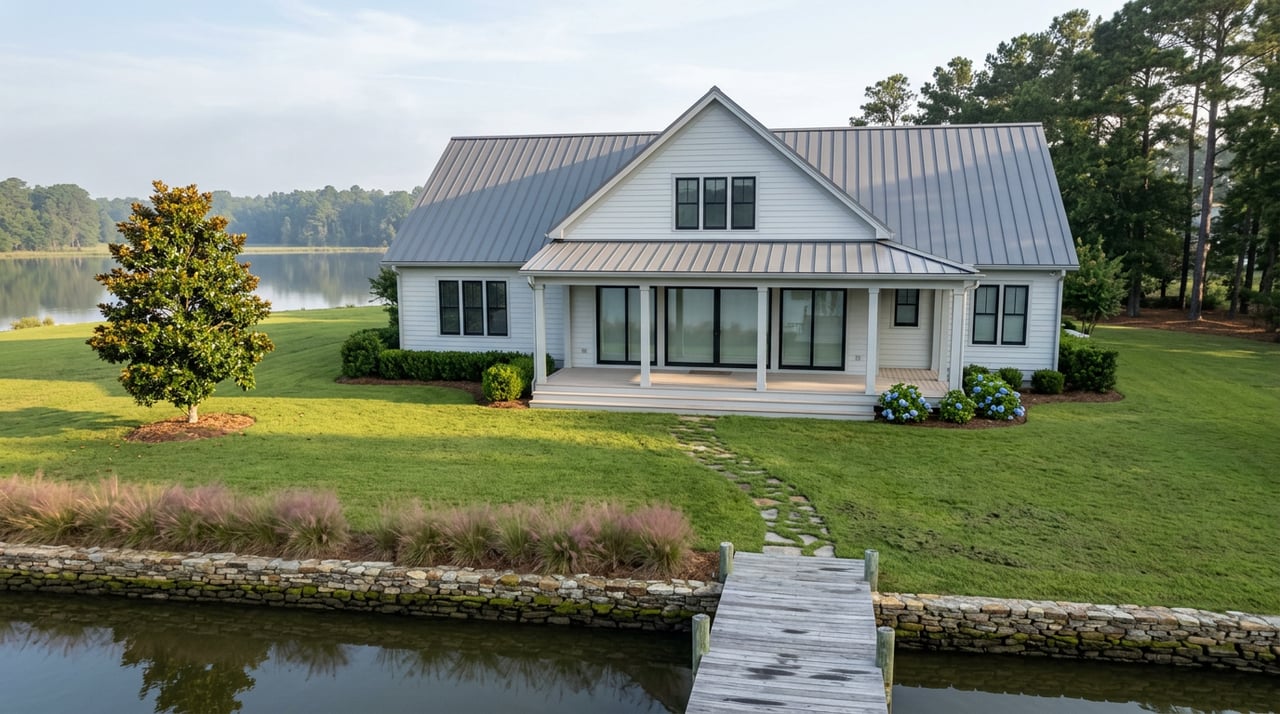
If you've been comparing Virginia Beach neighborhoods by price alone, Sandbridge will confuse you. It carries the highest median sale price in the city, yet homes there sit on the market about three and a half times as long as the Virginia Beach average, and the median price itself has actually fallen over the past year rather than climbed. That combination breaks the basic assumption most buyers bring to a search: that the priciest neighborhood is also the hottest one.
Sandbridge has a mix of residential and vacation-rental activity. Once you understand that mix, the rest of Virginia Beach's submarkets start to make a lot more sense, especially two that get compared to Sandbridge constantly for very different reasons: Great Neck and Kempsville.
The Number That Doesn't Move Like the Rest of the City
Over the trailing 12 months, Sandbridge's median sale price sits around $1,050,000, but that figure is down roughly 32 percent from the prior 12-month period. Homes there have been taking about 78 to 82 days to sell. Compare that to the rest of Virginia Beach, where the citywide median sale price over the three months ending in May 2026 was $415,000, with the typical home selling in about 23 days after drawing roughly two competing offers.
These figures show a contrast between Sandbridge and the citywide market. Price and time on market can vary across neighborhoods, and the discussion below considers how buyers' intended uses may factor into that comparison.
Factors Shaping Sandbridge's Market
Sandbridge isn't priced like a place people live full time, because most of the housing stock isn't used that way. The neighborhood has no hotels, no bar strip, and none of the commercial density you'd find at the Oceanfront a few miles north. What it has instead is a dense cluster of vacation rental infrastructure built around a Memorial Day to Labor Day season: one property manager alone lists more than 100 professionally managed rental homes, the Sandbridge Seaside Market does its steadiest business selling doughnuts and cooler supplies to beachgoers, and neighborhood spots like José Tequilas Mexican Grill and Bar and the waterside Baja Restaurant do their heaviest trade between May and September. Sandbridge Realty, a locally managed vacation rental company, has operated in the neighborhood for more than three decades, which tells you how long this has been the area's actual economic engine.
Many buyers here are underwriting a summer rental income stream first and a beach house second, which means they're running their own math on occupancy rates, weekly rental rates, and a shrinking shoulder season rather than reacting to what a comparable house down the street just sold for. That process takes longer, and it produces a market that's more sensitive to swings in vacation demand than to the mortgage rate environment driving the rest of the city.
There's a second layer of friction that's easy to underestimate until you're under contract. Sandbridge sits in a flood zone where insurance costs run higher than the Virginia average, and according to 1800 Insurance, flood insurance policies take 30 days to become effective after purchase, so a buyer can't wait until a storm is forecast to bind coverage. Virginia Beach does participate in FEMA's Community Rating System, which gives eligible homeowners in high-risk zones a premium discount, but the underlying cost still needs to be quoted and budgeted before closing, not after. Add in the fact that Sandbridge is typically among the first areas ordered to evacuate ahead of a hurricane, given its limited emergency access, and you start to see why deals here take longer to close even when the buyer is motivated. None of this makes Sandbridge a bad purchase. It makes it a different kind of purchase, one where the math looks more like buying a small business than buying a house.
Great Neck: Water Access and Home Prices
Great Neck tells a different story. The median home price there runs around $430,000, though that number climbs quickly near the water, with homes close to Broad Bay or with private dock access often pushing past $600,000 and true waterfront properties occasionally clearing $1 million.
What you're paying for in Great Neck is water access without oceanfront pricing. The neighborhood sits on a peninsula between Broad Bay and Linkhorn Bay, and a meaningful share of homes have private docks that connect through canal systems out to the Chesapeake Bay. Most of the housing stock was built between the 1960s and 1990s, so buyers get mature trees and established lots rather than the tighter footprints common in newer developments, alongside a mix of original ranches and homes that have since been renovated or rebuilt. The neighborhood backs up to First Landing State Park, which covers 2,888 acres and includes 1.5 miles of Chesapeake Bay beach frontage and 20 miles of hiking trails, giving residents outdoor access that's hard to replicate inside a typical subdivision.
Great Neck is within a reasonable commute of NAS Oceana, Joint Expeditionary Base Little Creek-Fort Story, and Naval Station Norfolk. Schools zone to Frank W. Cox High School, consistently one of the stronger public high schools in the city.
Kempsville: The Workhorse Behind the Citywide Median
If Sandbridge is the outlier and Great Neck is the lifestyle play, Kempsville is the neighborhood that actually looks like the headline number. Median prices there run closer to $385,000, and it offers a wide range of housing options that fit different budgets rather than a single dominant price point.
Kempsville doesn't have Sandbridge's seasonal rental economy or Great Neck's waterfront premium. What it has is proximity, variety, and a buyer pool that's shopping the way most Virginia Beach buyers shop: for a place to live, not a place to monetize or a place to escape to on weekends. That's exactly why it tracks closer to the citywide pace than either of the other two.
Three Neighborhoods, Three Different Markets
| Neighborhood | Typical Median Price | What Drives the Price |
|---|---|---|
| Sandbridge | ~$1,050,000 (trailing 12 months, down ~32% year over year) | Vacation rental income potential, seasonal demand, flood zone costs |
| Great Neck | ~$430,000, climbing toward $600K+ near the water | Canal and bay water access, school zoning, military commute |
| Kempsville | ~$385,000 | Affordability, variety of housing stock, and range of price points |
Reading these three side by side, the citywide median of roughly $415,000 starts to look like an average of very different behaviors rather than a description of any one of them.
What This Means If You're Comparing Neighborhoods
The mistake most buyers make when they start neighborhood shopping in Virginia Beach is treating the median price as a proxy for competitiveness. It isn't, at least not consistently. Before you assume a higher price means a hotter market, check how long homes there have actually been sitting and ask what kinds of purchases are driving that number. A neighborhood where buyers consider rental income may behave differently from one where buyers are seeking a primary residence.
If you're weighing a purchase in a flood-exposed area, get a flood insurance quote before you're deep into a contract, not after, since the 30-day effective date on a new policy can complicate a fast closing timeline. The City of Virginia Beach's floodplain management program outlines elevation certificate requirements that affect both your premium and what you're allowed to build or modify later, and it's worth reviewing before you fall in love with a specific address.
A Few Questions Worth Answering Before You Choose a Neighborhood
What does a falling median price in Sandbridge mean? The median price alone does not explain the change. Anyone evaluating a Sandbridge purchase can consider rental income potential and seasonal occupancy trends alongside the sale price.
Why does Great Neck cost less than Sandbridge but sell faster? Because the buyer pool is different. Great Neck sells to people planning to live in the house year round, which produces the kind of steady, comparison-driven activity you'd expect in a typical residential market.
Is Kempsville a good starting point if I'm not sure which part of Virginia Beach fits me? It's a reasonable baseline precisely because it tracks closest to the citywide median and pace, which makes it easier to compare against more specialized neighborhoods like Sandbridge or Great Neck once you know what you're actually optimizing for.
Every one of these numbers changes the moment you narrow from "Virginia Beach" to a specific street, school zone, or flood map. If you're trying to figure out which submarket actually fits your budget, your timeline, and what you want the property to do for you, that's exactly the kind of comparison ELG Consulting Group works through with clients every week. Get Your Free Home Valuation and let's find out what your money actually buys in this market.
This article is general information, not legal, tax or financial advice. Consult a qualified professional about your situation.